The Long Walk: Tales of the Camino
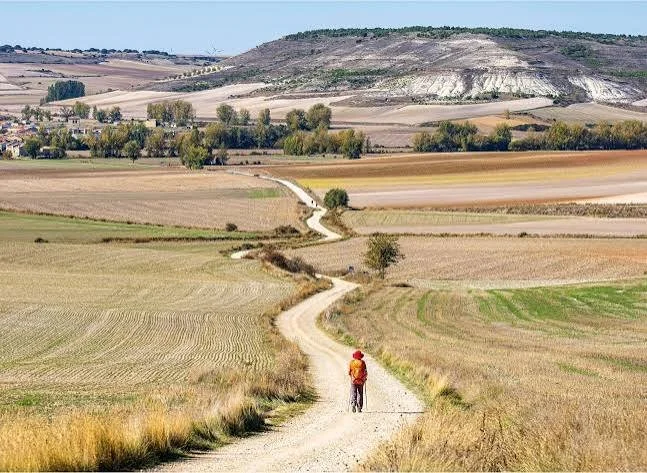
It is curious that individuals from all over the world will travel to one place just to walk. Mothers, fathers, students, seniors, vagabonds, and nature enthusiasts all find purpose on the Camino de Santiago. Each journey is entirely their own, yet isolation is uncommon along the path. The Camino de Santiago is an ancient pilgrimage that follows the burial route of Saint James, or, as he’s more commonly known here, Santo Santiago. The path has survived conquests, religious battles, and wars. Stretching across 29 countries throughout Europe, its full length isn’t completely known but is estimated at over 50,000 miles (80,000 km). The Camino’s most common routes (Camino Francés, Camino Portugués, and Camino Inglés) pass through France, Portugal, and Spain, and each leads to Santiago de Compostela.
Although originating in Christian roots, a modern-day Camino does not discriminate: Muslims, Hindus, Jews, and atheists—the path welcomes all. A pilgrim’s incentive for enduring the walk varies from person to person. It may be for faith, adventure, or a bit of soul-searching. Mine was somewhere in between. In 2021, after suffering a handful of fainting episodes during the pre-season of my sophomore year in collegiate basketball, I was diagnosed with a severe congenital heart defect. It made me high-risk for exercise-induced cardiac arrest. I was scheduled for surgery in December of that very same year, igniting the health anxieties and panic attacks that were once foreign to me. My relationship with my body became severed, and I saw myself as more of a host in a failing vessel than a human being. After five years of incisions, scars, and a LOT of therapy, I have finally found some respite.
I was scrolling through TikTok when I came upon the Camino de Santiago. A young woman’s voice dubbed over footage of rolling hills, crashing coastal waves, and strangers sharing meals together. She spoke of monasteries that stood the test of time, fishing villages that offered her warm meals and a bed, and the joy she felt as she stood gazing up at her final destination: the Cathedral of Santiago de Compostela. I quickly clicked the blue links in the comments, the ones that took me to other Camino de Santiago searches in the app, and marveled at the trail's beauty. I was completely hooked.
I started searching traveler blogs and social media accounts for anything about the Camino. I scrolled through pages of recommended items, looking for the best backpacks, shoes, and socks. I researched the different paths, eager to learn what set each one apart and what unique vistas it offered. I created a Notes page to track my findings, filling it with links, books to read, and trail notes. It was February, and everything I read said the best months to go were May, June, September, and October. From what I learned, I wanted to walk the Senda Litoral, which follows Portugal's coast to Spain, where it merges with the inland Camino Central. So I booked a plane ticket to Porto, Portugal, for September, then a return flight from Madrid two and a half weeks later.
When I told my friends and family that I would be walking roughly 170 miles over two weeks, I got mixed reviews. One friend in particular looked completely shocked and said, “Not my journey, girl, but go walk those marathons!” Other family members were either horrified, excited, or dumbfounded that someone would spend their vacation days walking nonstop. My parents were the most concerned, primarily for my safety. I would be traveling alone, without a group, across two countries, as a young girl in my early twenties. After a few late-night conversations, they asked if they could join me for the second half of my journey and meet me in Vigo, Spain. I was reluctant at first because I truly wanted to regain independence, confidence in my body, and prove to myself that I could achieve great things on my own. But after some thought, I realized that if anyone were to join me on this Camino, I would want it to be them.
In the months leading up to the trip, we practiced walking for longer distances. My parents would be using one of the various Camino luggage services that transport your suitcases from hotel to hotel, while I planned to carry my pack. So along with training for the 15-mile days ahead, I also walked with my Osprey backpack and a few weighted items. Some people I met on the path had been training like me, and others hadn’t walked more than a few miles at a time before arriving in Portugal. There’s no “right” way; there’s only the way that works for you.
But as much as I prepared, I was all nerves when my plane landed in Porto. I quickly found a taxi and headed to my hotel in the heart of the city. Jetlagged and hungry, I unpacked and began wandering the streets for a meal. At a restaurant by the river, my nerves finally settled, and the excitement kicked in. I was in a gorgeous city, eating seafood and drinking wine with a view of the water. The pace that I was so accustomed to in the States started to feel foreign and rushed. Tomorrow, I'd start the journey of a lifetime.
After my meal, I walked to the Porto Cathedral in the historic Morro da Sé district. I spent a few hours admiring the church’s traditional azulejos (hand-painted blue-and-white mosaic tiles) depicting biblical figures and scenes. I walked from tall, gold-drenched rooms to subtle stone nooks that housed tombs. I was one of many pilgrims who walked the halls that day, preparing for the long walk. Which brings me to one of my favorite parts of the Camino: the pilgrim passport.
The Church has long seen the Camino de Santiago as a formidable accomplishment. Since the Middle Ages, pilgrims have identified themselves by carrying scallop shells. Soon after, people began counterfeiting the shells to show the church and their community that they had made the pilgrimage without actually making the trek. So in the 13th century, the Church introduced cartas probatorias (evidentiary letters) as early travel identification. This was used until 1987, when the current standardized version of the Credencial was created to unify the rules and design of the pilgrim passport.
How it works: Pick up your pilgrim passport at the local church where you start your journey. I received mine at Porto Cathedral. To receive your Compostela certificate in Santiago, you’ll need to stamp and date your passport at least twice a day. Cafes, hotels, hostels, and albergues (subsidized hostels for pilgrims) offer stamps. Many businesses use intricate stamps, some made of wax, and others taking up a quarter of a page. At the end of your voyage, your pilgrim passport will look more like a piece of art than a credential. It’s a wonderful reminder of all the small stops you made along the way.
With my pilgrim passport and shell in hand, I had nothing left to do but sleep and wait for morning. I slept soundly and woke eagerly to my early alarm. I got ready, strapped my shell to my bag, packed my things, and set out for my first day. It was a delicious, foggy morning. The air was clean, despite its thickness. I listened to the playlist I shared with my family, who added their favorite tunes—a warm reminder of home. The ocean was gentle that morning, providing small gusts of wind from the left. About an hour later, I saw my first fellow pilgrim. They passed by me, sharing the first of many “Buen Camino”s. This phrase would be echoed throughout the voyage as a greeting, a goodbye, and a passing through. I returned the saying happily.
After stopping a few times for meals and rest, I noticed my feet were starting to hurt—not a great start to a two-week journey. I knew that the sharpness meant blisters, so I braved a look at the damage. Blisters of various sizes and depths were budding in 5 hot spots. Although I had trained in these shoes with a weighted pack, I hadn’t accounted for the extra lbs a water bottle and toiletries would add. The weight changed my gait, putting pressure on different angles of my feet. The worst, in particular, was a nickel-sized blister on my pinky toe.
Luckily, I also brought my Tevas. After some bandaging and moleskin, I strapped on the Velcro sandals and took off. Blisters were inevitable; I knew that I would probably get some. And I wouldn’t let them stop me from standing beneath that cathedral in two weeks' time. It’s funny; before this trip, I always hated blisters. Each one felt like a personal “F U” with every step. But after walking with them for two weeks straight, I was forced to find a way to embrace them. Even though it hurt, the pain reminded me that I had a body healthy and fit enough to walk at all.
There’s another saying on the path: “The Camino Provides.” I didn’t really know what it meant before I arrived in Portugal. On that first day, as I dressed my wounds on a lone stump by the ocean’s edge, a stranger approached me, asking in a thick German accent if I needed any bandages. I said, “No, thank you,” and “Buen Camino.” A few minutes later, a second stranger approached me. She asked me if I needed any help. I repeated that I was alright and thanked her for the offer. I realized then that what the Camino provided was community around a common goal. The Camino brought out goodness in people and let them share it with others.
I found community in 5 minute conversations with passerbys, and I also found it in the pilgrims who shared their days walking with me. On my third night, I ate alone at the hotel restaurant in Esposende. As I stood up after paying for my meal, the couple sitting at the table next to me asked if I was from the States. I said yes and asked where they were from. We spoke like that for the next five minutes, learning about each other's lives. I would be staying the next morning until breakfast opened at the hotel, whereas they’d be leaving much earlier to try to beat the afternoon sun. We said our goodbyes and Buen Caminos, and that was that. Or at least I thought it was until I ran into them again the next day. There was construction along the coastal walkways, so I had to divert to the main road. A group passed by me, and we echoed good mornings, until I heard, “Mina?” I looked up and saw the same couple as the night before. “We thought that was you! We almost passed you by!” Their clothes hadn’t dried well the night before, so they made a pit stop at a laundromat, putting them right on my path. We started walking together and kept walking together for the next few days. A good conversation is a great painkiller, and time flew by when I walked with my “Camino Parents.”
There were a million things that could have prevented us from running into each other. I could have left early like they did, or they could have decided to sleep in. Their clothes could have dried, or I may have needed the bathroom, or if they hadn’t stopped to talk to me in the first place… there were a million reasons why we needed to meet. Despite our differences in age, career, and creed, we found solace in one another's company. The Camino provided for me a second time in an offering of friendship.
It made another offering on my hardest day of the entire journey. My parents (my actual parents) were meeting me in Vigo the next day. Where most people would split a trip from A Guarda to Baoina in two days, I was doing it in one. It was 21 miles of hills, forests, and highways—but I had to do it if I wanted to meet my parents at the hotel. After walking the first half of the day with my Camino Parents, we parted ways when they arrived at their destination in Oia. My view for the rest of the day was mostly highways and coastlines. I noticed on my Camino Ninja app (a Camino de Santiago path planner) that there was a shortcut coming soon that crossed inland rather than taking the longer route around the pointed coast. I was losing daylight, behind schedule, and would soon run out of water. So I took it. The “shortcut” was a 300-meter mountain. 80 degrees and counting, I was slick with sweat and dirt from the rough terrain. It was so late in the day, I hadn’t seen another pilgrim for the last couple of hours. If I needed help or a ride, there was no easy way that they could reach me. It was just me and the mountain.
My breath was laboring, and my thighs were burning. I had drank the last of my water before I reached the top. Exhausted, I eased my way to sitting on the side of the mountain trail. I focused on my breathing; not trying to slow it down, but to steady it. Suddenly, a passing coastal breeze made its way to my rest stop. I could smell the distinct salty air I had grown so accustomed to over the last week. It felt like life had breathed into me. I got up, dusted the brown sand off my Tevas (yes, I was still wearing those), and made the final push up the mountain.
“The Camino Provides” meant so much more to me in that moment. It didn’t hand me a refilled water bottle or a pair of sneakers. It gave me the chance to find gratitude in the simplest things: a passing coastal breeze, a bit of shade, a stranger to connect with. The only reason it was a gift was because I was ready to receive it. When your days are reduced to one foot in front of the other, you find life much more interesting than before. With the volume turned down, the things we overlook become that much more noticeable.
I watched my parents learn those lessons in real time. If we lost cell service, it was an opportunity to be present. If we got lost, it was a rewarding challenge to find our way back. The phrase that we repeated throughout our trip was “Take Heed.” My mom said it first when they arrived. “Sherwin, our daughter has been here for a week already. She knows the ropes. Let’s take heed!” My dad, like most dads, is the “map guy”, the “planner”, the “head honcho”. He’s used to having that control. But our only objective each day was to follow the yellow Camino arrows to our destination. We couldn’t break into a run to get there any faster, and we couldn‘t control the weather. But we could keep walking. Our definitions of “control” were obliterated. I noticed my dad’s behavior change by the second day. On this particular trip, his emphasis on being a leader was better placed in being a follower. As a family, we learned together that life is too short to take so seriously.
We played card games in small cafes; we holed up in vineyards for a bit of respite. We conversed with lovely strangers. We navigated mismanaged Airbnb stays. And we laughed a LOT. That second week flew by in a blink. Before we knew it, we were approaching Santiago. On our last day, the energy was high. After merging routes with the Camino Central, all the pilgrims followed the same path. That first view of the cathedral, some 12 miles away, was otherworldly. Just two weeks ago, I was jet-lagged in a different country. Now, I strongly marched with my family to the finish line. Was I sore? Yes. But my gratification outweighed every pain. As we approached the cathedral, the streets narrowed into cobblestone markets. A mix of pilgrims, vendors, and tourists lined the alleyways. I felt large as I moved through the crowds.
The cathedral looked even better from beneath it. In the courtyard, people shouted, pilgrims hugged in groups, and most lay down to take in the view. I didn’t know whether to cry, laugh, or shout, so I chose silence. My parents did the same.
That night, after receiving our Compostela certificates at the pilgrim office, we attended Mass at the cathedral. We’re not religious, but we know when to show admiration. The sermon was given in Spanish, and even though I am fluent, I couldn’t make out many of the religious phrases. But to look out at that sea of people, demonstrating virtuous faith in their beliefs, I felt like I understood every word.
We headed back to the States soon after. But not before catching dinner with my Camino Parents. I knew they would all get along, but seeing it in real time was wonderful. Conversation flowed throughout the evening, and at one point I sat back and looked at the scene before me. This dinner, this communion, was evidence of the Camino's gift. We were all a bit bloodied and a bit bruised, but we found connection in a voyage done in isolation. Even when I was alone, I was never lonely. This was proof of that. We hugged and said our goodbyes, promising to call and visit when we could. On that final walk back to the hotel, I stared at the same moon I have at home. That night, it looked a little brighter, a little fuller, and a little more peaceful than it had just two weeks before. And I was grateful for it.